

The Quiet Problem of Sideways Promotions in Early Childhood Education
Educational Leader roles in early childhood education are increasingly becoming what many educators recognise as “sideways promotions”, roles that carry greater responsibility, accountability, and expectations without the time or pay to match. While the position is critical to quality practice, many Educational Leaders are left to fulfil its demands in unpaid hours or alongside full teaching loads. Proposals that offer either additional time or additional pay, but not both, risk entrenching this imbalance. If leadership is to be sustainable, the role must be properly resourced, with both protected time and a paid allowance that reflects its true scope and importance.

Rethinking Power in Sessional Kindergarten: Leadership in the Era of Centralised Management
In sessional kindergarten, centralised management is reshaping how power and decision making are distributed. While offering efficiencies, it can distance authority from educators and raise questions about whose voices and priorities count. Strengthening trust and genuine collaboration is key to ensuring leadership remains connected to those closest to children.

When Qualifications Don’t Count: A Growing Gap in Educator Pay
Award rates have shifted in response to gender undervaluation, but for many VECTEA employed Diploma qualified educators, the reality hasn’t. They’re still feeling the pinch, with pay that falls below the very benchmarks meant to recognise their work.

Rotational Kinder: A Policy Breakdown
Rotational kindergarten has been introduced in Victoria as a flexible, cost effective solution to increasing demand for accessing Free Kinder. While the policy promises expanded access, greater efficiency, and improved use of existing services, its practical implications tell a more complex story. This article examines how the model operates in reality, highlighting the tension between maintained ratios and significantly increased educator workload.
By unpacking the structure of rotational enrolment, the piece explores how key elements of quality, such as continuity of relationships, depth of engagement, and sustained shared thinking, are diluted when educators are responsible for a larger cohort of children across staggered attendance patterns. It also situates the policy within broader sector challenges, including workforce strain and rising compliance pressures.
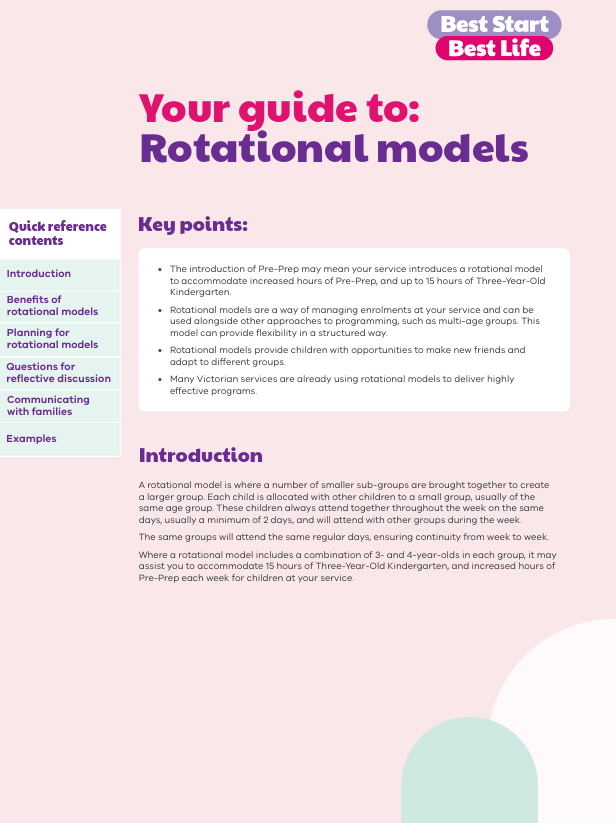
Rotational Kinder: Expansion Disguised as Innovation
Rotational kindergarten is increasingly promoted as a flexible solution to rising demand in Victoria’s early childhood sector. But beneath the language of innovation lies a quieter shift: expanding access without the investment needed to sustain quality. As enrolments grow and staffing remains unchanged, educators are stretched across larger, more complex programs, with less time for the relational and intentional teaching practices that underpin effective early learning. This piece argues that rotational models risk diluting what makes sessional kindergarten work, replacing depth with scale, and quality with compliance. At a time when the sector is already grappling with serious challenges, the move toward expansion without support raises critical questions about priorities, values, and the future of early childhood education.

Free Kinder and the Quiet Rewriting of Early Childhood Education
Victoria’s Free Kinder policy is widely celebrated as a cost of living measure that expands access to early childhood education. By removing fees and increasing funded hours, it promises to support families and improve participation across the state.
But beneath this surface level benefit lies a deeper structural shift. As funding models change and expectations around access increase, the role and identity of sessional kindergarten are being quietly reshaped. What was once a model grounded in educational depth, professional autonomy, and community connection is increasingly being drawn into a system focused on scale, standardisation, and delivery.
This piece explores how Free Kinder is not just a funding reform, but a values shift. It raises critical questions about what is gained, what is lost, and whether expanding access without equal investment in workforce, conditions, and infrastructure risks redefining early childhood education in ways the sector has not fully confronted.

33 Children in a Kinder Room: When Expanding Access Outpaces Quality
Victoria’s expansion of free kindergarten has increased access for families, but rising group sizes are changing the realities inside kindergarten rooms. This article explores the growing tension between access, quality, workforce sustainability, and the future of sessional kindergarten.

Reform Requires Respect: A Letter on Pay Parity and Retention
Victoria’s universal kindergarten expansion is ambitious, but the workforce delivering it is under increasing strain.
With VECTEA 2026 negotiations still underway, salary compression across Level 3 teachers, funding supplements that don’t translate into improved conditions, and ongoing retention pressures, many Early Childhood Teachers are asking the same question: who is reform really for?
As university-qualified professionals delivering education during the most formative years of a child’s life, we deserve meaningful salary progression, recognised leadership responsibilities, and genuine parity with other teaching professionals in Victoria.
In this post, I share a letter I have written to The Hon. Lizzie Blandthorn outlining concerns about pay equity, funding accountability, and workforce sustainability. If these issues resonate with you, I encourage you to adapt the letter and send one too.
Universal kindergarten cannot succeed without a respected and sustainable workforce.

Supporting Educational Leaders Under A New VECTEA: From Compliance to Best Practice
As the sector moves into the new VECTEA, there is an opportunity to shift Educational Leadership from a compliance-focused role to one grounded in best practice. By recognising the complexity of the role, allocating realistic leadership time, and embedding proper support structures, services can ensure Educational Leaders are empowered to drive quality improvement and strong pedagogical outcomes.

A Historic Shift Is Here…
A historic pay rise is coming for early childhood educators as the Children’s Services Award undergoes a long-overdue gender-based undervaluation correction. Here’s what it means for VECTEA educators, teachers, and educational leaders.

Fairness, Recognition, and the Future of Early Childhood Teaching
Recent policy changes by Australia’s largest early childhood provider have raised serious concerns about the recognition of Graduate Diploma and Postgraduate Diploma qualifications for Early Childhood Teacher (ECT) status. For many experienced educators, this shift represents more than regulatory adjustment -it signals a troubling devaluation of professional practice, lived experience, and sustained contribution to the sector.
Teacher capability is not determined solely by qualification pathway. It is shaped by commitment to professional learning, reflective practice, leadership, mentoring, and workplace culture. In a sector already facing workforce shortages and burnout, excluding an entire group of qualified and experienced teachers risks further destabilising the profession. Recognition must be grounded in demonstrated competence and ongoing contribution -not assumptions attached to qualification labels.
When Authority and Accountability Are Separated, Leadership Becomes Impossible
Leadership cannot exist where responsibility is stripped of authority. In early learning, risk is increasingly managed through documentation rather than judgement, while accountability is pushed downward and power remains centralised. This is not safety. It is system failure.

Rethinking School Readiness Funding: A Grassroots Perspective
School Readiness Funding (SRF) is designed to improve outcomes for children across communication, wellbeing, access, inclusion, and participation. But from a grassroots perspective, the way this funding is often used doesn’t always align with what educators and services need most.
Too often, SRF is directed toward external professional development, while the everyday conditions that shape children’s experiences, such as class sizes, staffing ratios, and in-room support, remain under-resourced. This piece reimagines what SRF could achieve if it were invested directly into the realities of kindergarten practice.
From smaller class sizes and improved educator-to-child ratios, to additional in room support and practical assistance for families, the focus shifts from theory to impact. It argues that meaningful change comes not from more programs, but from strengthening the conditions where learning and relationships happen every day.

Non-Contact Time: Intention vs Reality
Non-contact time was never meant to be an afterthought. It’s a cornerstone of professional practice, yet too often it’s lost to competing demands. This piece explores why leadership must step up to protect, prioritise, and reframe how we use non-contact time to sustain quality, wellbeing, and equity across the early childhood sector.

What Makes a Pedagogical Leader in 2025?
In 2025 pedagogical leadership is evolving. It’s about guiding teams, supporting families, and shaping learning culture in real-world conditions. Discover the skills, strategies, and systemic insights that define the next generation of early childhood leaders.

Celebrating Diwali: Embracing Diversity and Inclusion in ECE
Diwali offers more than a moment of celebration. It's a chance to honour cultural diversity, foster inclusion, and support every child's sense of identity. In this post, we explore why and how early childhood educators can celebrate Diwali with intention, care and respect.

Co-Educators: Undervalued and Under Utilised?
In Victorian sessional kindergartens, co‑educators greet families, reset classrooms, and provide the steady presence amid staff turnover. Yet despite their pivotal role, they remain largely undervalued and under‑utilised. This post examines the structural barriers, from limited career development and planning time to pay and title gaps, and invites educators, leaders and policy‑makers to imagine a future where co‑educators are recognised as the professionals they are

Sessional Kindergarten: A Meaningful Next Step in Your Early Childhood Career
Thinking of making the shift from long day care to sessional kindergarten? You’re not alone. With better balance, stronger community connections, and growing demand thanks to major reforms, sessional kinder is becoming a powerful next step for early childhood educators. Here's why it might be the move that reignites your career, and your sense of purpose.

VECTEA Classifications for Co-educators
Diploma and Cert III-qualified educators are essential to sessional kindergarten programs, yet under VECTEA, they’re locked into a flat classification structure with no path to progress unless they go back to university. This article explores why that needs to change and what a more equitable future could look like.

Is It Time to Rethink Non‑Contact Time in Sessional Kinders?
Non-contact time is meant to support educators to plan, reflect, and stay on top of compliance, but in sessional kindergartens, it’s rarely enough. As session lengths grow and workloads increase, it’s time to rethink how non-contact is allocated, protected, and valued under VECTEA.